
35 members and guests joined online and in person in Fairfield for an evening of photography, astrophotography, cosmology, observing reports and announcements. The meeting began at 7:00 p.m. and concluded shortly before 9:00 p.m.
Welcome and introductions
David Payne welcomed everyone and invited members to share images. A new attendee, Dylan, introduced himself as a second- or third-year University of Victoria student interested in quantum physics and astronomy. He had found RASC Victoria through Reddit.
Randy Enkin: Sunrises and seascapes from the CCGS John P. Tully
Randy described a three-week trip aboard the Canadian Coast Guard ship John P. Tully, working mostly north of Vancouver Island. The team was developing geological maps of the seafloor, examining changes in sea level and the effects of glaciers, and studying where and when earthquakes had occurred. They also worked on seafloor acoustics with the Department of National Defence. Their sounder could penetrate the mud; Randy said they did not use “boomers or sparkers.”
October weather was often rough—what mariners call “snotty” weather—which made work difficult as the ship pitched. The crew sometimes moved into more sheltered water. Randy used the Windy app to follow conditions and noted a corridor of calmer weather between stronger winds to the north and south.
Randy shared photographs of sunrises, sunsets and cloud formations. The ship’s route and weather often left the horizon clouded, but occasional openings let sunlight through for only seconds or minutes. He described the patience required to catch those moments, including eerie glows, dramatic shadows, red under-lit clouds and reflections on the water. He hopes to photograph a glacier peak over Juan de Fuca Strait another time.
The images prompted discussion of atmospheric optics and related phenomena:
- Randy described the blue sky in terms of Rayleigh scattering: shorter blue wavelengths are scattered through the atmosphere, while red light is more likely to remain along the direct line of sight. In the underlit clouds, the group could see a gradation of colour from blue to red.
- One photograph showed curl-shaped Kelvin–Helmholtz waves, formed where layers of air move at different speeds. Similar wave patterns can be seen in nebulae, on Jupiter and in the Sun.
- The group discussed the green flash at sunset. Blue light is scattered away near the horizon, while atmospheric refraction separates the remaining colours; under suitable conditions, a brief green appearance can be visible.
- David Lee explained that starburst rays around the Sun in photographs are diffraction artifacts from the camera lens aperture. The number and visibility of the rays depend on the lens design and aperture. A telescope’s secondary-mirror supports can also produce diffraction spikes.
- Randy showed the golden-hour light after sunrise, when sunlight travels through more atmosphere and gives scenes a pink or orange cast and deep shadows. He also showed the Belt of Venus: a pink band above the horizon, with Earth’s shadow below it.
Other images included seabirds gathered around fishing boats (the ship was collecting mud, not fish), wind turbines in northern Vancouver Island, Cape Scott and the port beneath Mount Baker as the Sun rose behind the mountain. Randy also showed a reflection of the ship’s wake on calm water. Laurie asked whether one location was Triangle Island; Randy said it was nearby, but they did not see puffins because it was the wrong season.
In response to a question about sunset camera settings, David Lee said digital settings can be adjusted to taste. Joe Carr suggested reducing exposure compensation by roughly 1½ to 2 stops, shooting RAW and refining the image in post-processing. Randy added that he had photographed orcas and made adjustments after.
Joe Carr: Astrophotography with a Seestar smart telescope
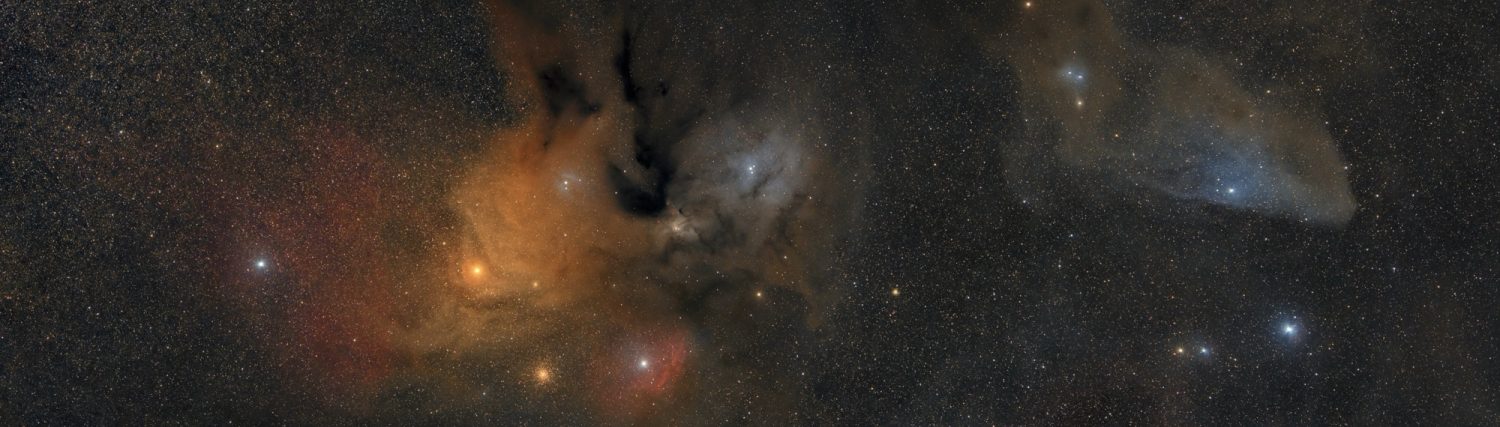
Joe began with a photograph he took in Costa Rica in late February 2009, located about 10 degrees north of the equator. Taken shortly after midnight with a modified Canon Rebel XTi at 70mm focal length, the image included the Southern Cross (Crux), the Carina Nebula, Eta Carinae and the Southern Jewelbox open cluster. Joe pointed out the Coal Sack beside Crux as a useful guide to finding the compact Southern Cross and distinguishing it from the larger False Cross.
He reprocessed the original data using modern tools. The updated result had tighter stars and more visible detail in the Carina Nebula and Southern Cross. Many of the original frames had been compromised by clouds; the new workflow let him discard those frames. Joe described the processing as an adventure and mentioned using StackingWizard, AstroWizard and Russel Croman’s star-separation tools.
Joe then showed recent images made with a Seestar telescope from the Victoria Centre Observatory and from his neighbourhood playing field. Joe Carr’s Seestar image gallery
- The Pinwheel Galaxy (M101), with several smaller galaxies visible in the field, including an edge-on galaxy near a corner.
- The Double Cluster in Perseus, where the star colours came through well.
- Wide-field views of the North America Nebula and the Sadr region, showing extensive nebulosity and open clusters.
- The Crescent Nebula, Fish Head Nebula in Cassiopeia, Cocoon Nebula, Wizard Nebula in Cepheus, Lobster Claw Nebula, Bubble Nebula, Soul Nebula, Heart Nebula, Fireworks Galaxy and Lion Nebula.
- Galaxy groups including Deer Lick and Stephan’s Quintet.
Joe was pleased with the results from the Seestar despite limited resolution, and described exposures assembled from many short subs, often around 30 seconds each; examples ranged from about 14 minutes to 45 minutes total integration. He usually runs the telescope in equatorial mode and said the stacking software registers the frames. David Lee noted that short exposures help when imaging without guiding. The Seestar images were broadband LRGB rather than narrowband, though hints of blue and green appeared in some targets.
The group discussed the telescope’s mosaic function, which uses the app to move across a target area and combine panels, as well as a newly added photometry feature. Joe said that a small, portable smart telescope makes it practical to take advantage of a short clear spell without setting up a larger system. Its battery typically lasts six to eight hours, with a built-in dew heater that can reduce runtime; external power can also be connected. Joe said it comes with a travel case and a battery within the usual airline carry-on limit.
Ben compared the Seestar with Vaonis and mentioned new products from Vaonis and Dwarf, including a dual-scope model. He said the Seestar software benefits from ZWO’s experience and is less expensive than some alternatives. Joe also mentioned Celestron and Sky-Watcher. The group agreed that the convenience of smart telescopes gives them a useful niche alongside traditional equipment.
David Payne: “Why We Should Think of Space as a Thermodynamic Continuum”
Attribution: The following is a summary of David Payne’s presentation and the discussion it prompted. It records his proposed interpretation and criticisms; it does not represent an endorsement by RASC Victoria or a statement of scientific consensus.
David Payne introduced the talk as an overview of a manuscript he is writing. He proposed describing outer space using the continuum physics and thermodynamics used for matter on Earth. He contrasted two broad approaches: a particle-based picture of objects moving through largely empty space, which he associated with a Lagrangian or “billiard-ball” model, and a continuum picture that represents matter and spacetime as fields, which he associated with an Eulerian description.
Payne argued that continuum models, including fluid dynamics and stress, could provide a more complete account of astrophysical processes. He emphasized that continuum equations describe changes across space and time and that, in his view, they bring thermodynamic irreversibility—through such effects as viscosity and stress—into cosmology. He traced historical links between practical heat engines and the development of thermodynamics, discussing energy conservation, entropy and the second law. He described entropy as giving time an arrow and argued for a connection between increasing entropy and the expansion of space.
Payne then applied this framework to stars, galaxies and cosmic structure. He compared stars with heat sources that release energy to their surroundings and suggested that galaxies and an expanding universe could also be understood through thermodynamic processes. He criticized explanations that rely on gravity alone to produce structure, arguing that they do not account adequately for thermodynamics and material stresses. He also challenged aspects of the standard Lambda-CDM cosmological model, including its treatment of dark matter, dark energy, galaxy structure and black holes. He proposed that an “entropic expansion” concept might replace dark energy in a continuum account.
Payne referred to work by researchers including van der Waals, Knudsen, Lennard-Jones, Kadanoff, Bekenstein, Hawking and Jacobson, and discussed the possibility of relating gravitational equations to thermodynamics and entropy. He said he hoped to develop the manuscript further, post it on his APRealSpace website and seek publication, possibly in a thermodynamics journal.
During questions, Randy recalled the divide between reductionist particle physics and continuum approaches, and said he found Payne’s argument thought-provoking. Payne explained that his interest grew from a career in engineering and science and later reading in quantum physics and astrophysics. He said he had become concerned that cosmology had moved too far from familiar terrestrial physics. He also discussed the distinction between an object’s composition and its physical phase, using gas giants as an example.
Ben cautioned that the relationship between astrophysics and terrestrial physics is not a complete disconnect: stars’ radiation and planetary states can be studied using well-understood physical laws, and there is evidence informing questions such as galactic rotation curves. Payne agreed that one could infer additional matter from observations, but objected to treating unseen matter as a wholly different or “mythical” substance. He called the talk a teaser for a longer discussion. In response to a question about next steps, Payne said he planned to continue writing and make the work available online.
Announcements and observing reports
Events and publications
David Lee noted that a nova was currently visible. Laurie said a few calendars and other publications were still available and invited interested members to email her. She also announced the Friends of the Dominion Astrophysical Observatory’s annual general meeting this coming Saturday. The event will include a send-off for Ben Dorman, who is leaving the board after years of work, and an opportunity for attendees to bring telescopes for observing. Garry thanked Ben for his service.
David Lee: Early-morning observing
David shared early-morning photographs made with a Japanese star tracker. Around 5 a.m., while it was still dark, he captured Mars and the Beehive Cluster; his notes also record Jupiter and Regulus in the eastern sky and Gemini in view. He showed a closer crop and a pre-blue-hour image. David keeps the tracker near his front door so he can set it up quickly, and encouraged members to get up early to see Orion and the planets.
Phil Stooke: Space mission and minor-planet news
Phil reported on a Japanese mission launched to reach the Mars system the following year and return a sample from Phobos. He also mentioned a small, poorly characterized object reported by the Minor Planet Center in a loose orbit near a solar-system Lagrange point. He said the last comparable object in the Earth–Moon system had been noticed in April 1970, around the Apollo 13 mission, and speculated that it might be a piece of hardware such as a hatch or upper stage. The object could be easier to observe in November. In response to a question from Garry, Phil said the Japanese mission used a large H3 launch vehicle.
Japan launches spacecraft to mysterious moons of Mars – CBC
Vince: Imaging while travelling Spain
Vince shared a photograph from a trip to Spain, where he competed in the national triathlon team’s world championships and finished 25th. Vince showed a Soul Nebula mosaic made from his Victoria backyard with an 80 mm telescope, still in progress, and images he made in Spain—including the North America Nebula and Triangulum Galaxy—from a courtyard and a hillside. Dan Hogan had lent him a Dwarf smart telescope.
He described the challenge of bright European skies: in one location the telescope could not lock onto stars, and at another he was able to track M31. He also joked that one observing session replaced sleep before the race. David Lee noted that smart telescopes have the advantage of being able to run while their owners rest. Vince hopes to use future trips to reach southern targets that he has not yet imaged.
Near the close, Dylan mentioned a finding concerning the deuterium wave function extending beyond the strong nuclear force. Vince connected this to nuclear magnetic resonance and replacing hydrogen with deuterium. The meeting wrapped up after 8:57 p.m.
These meeting notes are compiled from Dan Hogan’s and Joe Carr’s meeting notes, merged using ChatGPT with subsequent minor editing by Joe.
The following week’s Astronomy Café on Oct 26th will be hosted by Randy Enkin and will feature Florida planetary imager Gary Varney presenting his Moon Trek series.