This is an edited AI-generated (Zoom) transcript of Gil’s presentation to Astronomy Cafe – Apr 20, 2026
Peter Jedicke
19:02:05
Well, so our first presentation is about the Large Binocular Telescope. Let me introduce Gil Esquerdo. You see Gil on your screen there. Gil is sitting in his office at the Planetary Science Institute.
in Tucson, Arizona.
Gil has been friends of the London Centre since he spent a year in London back in the early 2000s, which is now 25 years ago, and time just flies by. But we’ve maintained our friendship all along, and I learned.
Just in the last month or so that Gil has.
changed from his, uh, long-time position as an operator, uh, at the multiple… no, at the… at the Mount… on Mount Hopkins Observatory. I’ve forgotten the name of the telescope, but it was not the Multiple Mirror Telescope. And, uh, Gil was an… was an observer there for many years, and he’s a very keen astronomer. He’s…
Told me some wonderful anecdotes about how he got interested in astronomy as a youngster growing up in not one of the bigger cities in Arizona.
and so he’s he spent pretty much his whole life living in Arizona, and has gone to wonderful things like the Grand Canyon Star Party. He drives a little.
a little mini with his asteroid number on the license plate, which is a really cool idea, much supported, and his telescope fits in the back, if I remember correctly.
Gil
19:05:02
Barely.
Peter Jedicke
19:05:03
All right. So, Gil, Gil, you’re, you’re, you’re.
Gil
19:05:04
Barely.
RASC Victoria
19:05:05
The passenger?
with that.
Gil
19:05:07
It’s the only passenger, there’s no room for anything else beyond it, and me.
Peter Jedicke
19:05:11
I… I never thought to ask that. So… so Gil has just, uh, transferred over to the Large Binocular Telescope, which is a pretty amazing piece of equipment. Those of you who’ve spent time in Arizona have probably heard of it, but I…
I’m kind of… I’ll bet you there’s a pretty good chance none of us have actually visited there, other than Gil having been there to work. So, Gil, I’d love to hear you talk about the LBT for the next little while.
Gil
19:06:19
And then a little full screen action to make this happen. So here we go. So as Peter was saying, I just started the Large Binocular Telescope at the beginning of this year, and it was a bit of a change for me to go from operating a 1.2 meter aperture telescope to.
to 8.4 meter aperture telescopes. So it’s been a big step, as you might imagine. And my joke to a lot of folks is, well, what’s it been like? I said, it’s been like drinking from a fire hose, because there’s been an awful lot to learn.
But again, I just wanted to mostly give a nice overview of the site, of the telescope, what it’s like. Peter’s already seen a bit of this when he was here over the winter. I sort of data-dumped on him and all the friends and whatnot who are here in town anyways.
But I figured this would be a really nice introduction for, for you all, because you, it’s one of these weird places that, the observatory does do tours, but they’re highly seasonal because the road is not easily passable in the winter. So the problem is.
You’re all avoiding the worst of the snow by coming here in the winter. We’re not open to the public in the winter. So when you’re here in town and able to make a tour, you wouldn’t be able to do it anyways. So I either recommend come in the summer and suffer through it.
What I’d never realized, and on my first drive up to the observatory, and this was basically what I was presented with, is just the scale of this.
Um, this building is 10 stories tall.
Um, there’s the little Jeep that I drove up sitting there, and I’m looking up at the road, you can see the parking lot above it. Um…
It’s the size of a house, but it moves. So when you’re looking at this building here, there’s two parts. There is the fixed structure, which is the darker green and the lower section there, the sort of circular part, and then the rotating structure. And the rotating structure is the silvery part up above.
And the rotating structure weighs in at 2,400 tons and sits on these four gigantic bogies that are basically the size of a van, but they’re on train tracks. And so the building is sort of slave to the telescope. So as the telescope moves in azimuth.
the building follows it along. And then, of course, the telescope itself can move in altitude inside the structure. What you don’t really see from here is the shutters are facing away from us. You can’t really tell what side opens, what doesn’t. It’s actually on the other side of the building.
These four… looks like a giant cannon pointed out the size. That’s a vent port that’s about 2 meters across.
And that basically ventilates the layer of the building just below the observing floor level of the telescope.
Unfortunately, it’s tough to get a really good picture of the telescope that shows scale. The building is not much bigger than the telescope itself. For obvious reasons, you don’t want to ventilate a gigantic building that you’re not occupying. So there’s only a couple of pictures here that show.
scale. But there I am actually on the telescope structure. That mirror is 8.4 meters across. There are 2 of them, as the name might indicate, and what you really don’t see from this frame is on the other side, hiding behind all that structure behind me.
is the other telescope, and they are co-mounted physically on the same structure, so as the telescope moves, both mirrors are going the same place. Um, so it’s a…
very different than what you’re used to thinking of when you think of a telescope, even a large telescope. Again, simply because you’ve got this enormous structure, and how do you hold all this in place and make it work?
Um, okay.
Okay, I can’t. I’m gonna have a tough time with this. Sorry, gang. I thought I demoed this, but didn’t demo it while I was actually on Zoom. So the telescope itselfis quite remarkable.
Oh.
When you…
Whenever you see a picture of, say, the 5… the 200-inch, the 5-meter at Palomar, or the 4-meter on Kitt Peak, you see this very large, shiny structure that it sits upon, and those… those telescopes, they’re actually sitting on oil pads, and the oil pressure turns up, and the whole telescope floats.
on these oil pads, and the Ledge Binocular Telescope is the same way. So when you look at this picture, you see that large, shiny surface sitting there, kind of aimed right at us. That’s one of the two.
by bearing surfaces the telescope is sitting on. So it’s sitting down near the bottom. That’s actually the pads that it’s sitting on, and then the telescope can move in altitude this way on those giant pads.
Gil
19:11:33
What you really don’t get a sense of, though, is how deep.
Those primary mirrors are so bunch of amateur astronomers. You all understand F numbers that primary mirrors f 1.1 2 5. So it’s a very, very fast optical system. And in all the pictures I’ve taken I cannot get one that really shows.
how deep the bowl of that mirror is when you’re standing next to it. I joke, it’s almost like a giant bird bath, just incredibly deep. What you really get a sense for here though, this is looking all the way up. And so at the very top of the photo there, you see the secondary mirror of the telescope.
And what you’re noticing is that it doesn’t have the normal.
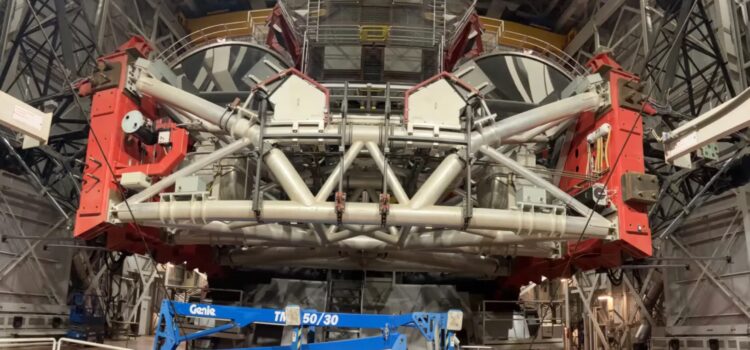
cross structure to hold a secondary mirror like we’re used to. What the telescope actually uses. We call them swing arms, and they’re these giant sort of A-frame structures that can move in and out of the optical path of the telescope. So the telescope is almost infinitely convertible.
So one of the interesting things with the optical design of the Lbt. Is, it is not what you’re used to thinking of when you think of a telescope. You think of a casic grain design. The Lbt. Is actually a Gregorian. So the primary mirror.
brings the light to a focus, the light actually comes and hits a concave secondary mirror, and then would come through a hole in the primary mirror. That is one of the modes that we can observe into the LBT, but…
What we do with that telescope is what’s called a bent Gregorian, and we actually put a tertiary mirror in the optical path above the hole, so we can put the light all the way through down the bottom, put an instrument to the back.
Or we can kick the light out the side and have the array of instruments over there. And it turns out the bent Gregorian mode is the one that we use the most often. So here’s another photograph. It shows the end of one of these swing arms. I’m again right at the level of the primary mirror.
you get a little better sense for the depth of the bowl in it, but we’re looking right at what we call M3, or the tertiary mirror, and that is the one that kicks the light out the side to the Ben-Gregorian mode, so basically those other ports where the other instruments are located.
Um…
In those, in that Ben Gregorian situation, you can sort of see that tertiary mirror on the far right hand side of the frame here, and you see all of these instrument ports that are aimed right at us. So one of the nice things is all of our instruments are always mounted.
There’s an instrument at Gregorian focus, basically down at the bottom. That’s 1. Here at this port there are 4 different instruments that I can command from the control room. So if in the middle of the night the observer says, I want to.
observe with Lucy rather than Pepsi. I can, with a handful of keystrokes, basically tell the computers this is now the instrument that we’re using. The mirror will move and pivot. There’ll be a small alignment that I’ll have to do, and then I hand the instrument off to the observers.
So in the middle of the night, one of the great flexibilities of this telescope is I can change from any instrument combination that the observers may want and do that in as short as five minutes or as long as 15 if there’s a bunch of swing arm changes necessary.
Um…
there’s a mode where we can observe two different instruments. So my other joke with the LBT is, you remember the line from Contact, after the first machine was destroyed, and Haddon basically was telling Elie Arroway, why build one when you can build two for twice the price?
That is the large binocular telescope, because every single instrument that’s on the telescope has effectively an identical twin. So each instrument that’s on this central gallery, and I’ll show you a better example of that in a second. Has a twin, and it may not be identical.
Many cases will have an instrument that is.
designed to work better in the bluer portion of the spectrum versus the red portion. So you’ll have the same instrument. But one’s a little more blue, sensitive, one’s a little more red, sensitive, and again, depending on the science the observers want to do will dictate which instrument the light’s being fed into.
In this central turret, in through here, one of the great powers of this telescope, and it’s unfortunately underused at this time, is the interferometer, where we actually take the light from both mirrors, combine the light in one place, and we can use that as an interferometer to get higher resolution data.
out of the telescope than you would with just a single mirror.
Oh.
So here’s a view of the telescope pointed over at the horizon. And again, it’s a case where you’ve got this thing shoehorned into this building. So I can’t get far enough away to really show it off, but you can see the top end of the structure staring right at us. You can see the top of the two primary mirrors.
Um, on either side there. And then there’s a big space in the middle. And that space in the middle we call the gallery, and that’s where all the instruments are located. And so, again, if you’ve got the interferometer, the light’s coming in, there’s a beam combiner, and that instrument is right in the center. Or you go ever so slightly off one to the other to get to those other instruments that are, again.
Gil
19:16:49
held in that gallery. The keen-eyed amateur astronomers of you may notice on the left-hand side, yes, that is a C14 on a Paramount, and that is our seeing monitor.
Um, so what would be a… an instrument that pretty much anyone would absolutely love to have in their own home observatory, we’re just using as a seeing monitor. So, just gives you a sense for how ridiculous and oversized all of this is.
Um…
Again. Unfortunately, it’s tough to really get a sense of scale. This is a case where we had the scope tipped over on its side, like you just saw in that previous picture. And there are 3 of my coworkers basically getting ready to go onto the structure of the telescope to to look at something. So I figured.
This was a nice photo to sort of show off and demonstrate just a little tiny bit of what the scale is like. But my first take when I got in the building was just how massive all of this really is.
Oh.
So where do I drive all this from? Here is my control room. When the observatory was originally put together at the very early aughts.
Let me step back quick. My position there is, it’s called the the operational.
Oh, I say operational.
specialist observer. And the idea basically is that the telescope is so complicated. I can’t do everything. I can’t operate the telescope and the instrument and decide science targets and keep up with quality control.
I’m only responsible for the health and well-being of the telescope. In a normal observing situation, historically, each of these stations might have a person or two at them. You’ve got one person controlling the instrument. You’ve got one person controlling our adaptive optics system.
Now, thank you, Zoom, as we can see right now, it’s uncommon for me to have someone else in the control room, so this is left over, just the size of it is left over from 20 years ago, but the big screen at the far end that’s off in this particular photo, that’s the Zoom session that we have open to the remote observer.
And they’re actually controlling the instrument and telling the telescope exactly where to go. My job is to make sure that they don’t do anything dumb.
a quick view out the window in the afternoon. But here’s a better look at what I’m staring at on a typical night. So again, everything is doubled, and we sort of split the screen in the middle. So the left hand telescopes on the left hand side, the right hand telescopes on the right hand side.
RASC Victoria
19:19:17
Okay.
Gil
19:19:29
You see the big rainbow color-coded plots there in the bottom. We are actively pushing and pulling on those primary mirrors to keep them in shape.
And so I’m seeing how much forces are being applied to those mirrors. Live. I can. I can actually watch that and make sure that there aren’t too many bending modes that are being over applied, and the things being stressed too much. The mirrors safe themselves. So if they do get out of control.
it will kill all of the forces applied to it and put it back at rest. But I’m watching, again, all of these displays and all these numbers that you see here, watching them in real time and seeing how those are going.
As amateur astronomers, we know our least favorite thing to do is collimation. The telescope has wavefront sensors on it. So you see the little grid patterns near the top. We are actively pulling a little bit of light from each telescope and measuring.
the views coming out of the optics and see how much of those bending forces we have to apply to the mirrors. So we are constantly collimating and focusing the telescope while we’re observing.
It does it on its own. It’s it’s remarkable sort of watching. When when I get on a new target, the telescope gets settled, takes a minute or 2, and I can watch those final bending moments get put in play, and I can see those those adjustments of get applied, and those the images improve.
I can watch that in real time, and then they snap into place, and I hand it off to the observer, saying, the telescope is yours, and just watching them constantly keep up throughout the night is kind of remarkable.
So the real big thing, though, most of what we wind up doing with that telescope is spectroscopy.
I’ve long joked that a picture is worth a thousand worlds, but for an astronomer, a spectrum is worth a thousand pictures.
But no one looks at a spectrum because they’re really not that pretty. So I thought I would show off some of the the more recent pretty photos out of the telescope. So this is no processing, nothing fancy. At the very top of the telescope, one of the things that I can put in is a prime focus camera.
And it operates at F1.2. So if any of you have or have used Hyperstar, we remove the secondary mirror from your Schmidt-Cassegrain, put that corrector lens in the camera in place. This is the world’s biggest, fastest Hyperstar.
Umm.
Yeah, it’s a remarkable thing to see. These are just a 5 minute exposure. The one on the left is sort of a V band, so sort of a green filtered. The one on the right is I, so like a very far red. This particular scientist is monitoring nearby galaxies. This is M101.
looking for pulsation modes in giant stars. And so once a month they’ll come in and take this suite of these amazing images, you know, out of the telescope, and sort of watching red giant stars in these galaxies change brightness over time.
Um, so again, this is a… I just… it’s a phone camera taking a picture of my monitor, um, but, you know, it’s… it’s never a bad night when they’ve got the cameras running, because you get a display like this.
Um…
a fun… this was actually my first run. I was still in the middle of training at the time. We have an instrument called Shark, and for those of you who’ve done planetary imaging, where you’ve got the high-speed webcam and you pull images out.
And you then use software to then, you know, pick out the better one, stack it, process it. This is that, but turned up to 11, because there’s adaptive optics running on this telescope, and they can then do similar, very similar way. You take a video stack, you then process the data.
This is a live, basically, snapshot from the Zoom screen, um, looking at a main belt asteroid called NISA. And so, you see sort of the interface that the observers are using here, but on the right-hand side, that potato-looking thing, that’s the live view of that asteroid, and over the course of about 6 hours.
We watched it slowly tumble and turn and rotate while they sat on this and observe this object.
This one just absolutely blows my mind. This is Europa.
This is an image again, using the sharks. This is a visible light image of Europa. And again, this is just me. I’ve peeled some images off of the zoom screen. This is one arc second across.
So you’re actually seeing surface details on a on a Galilean satellite with an 8 meter telescope. Again, what lets us do this, though it’s the power of the adaptive optics. You’ve got a mirror there that can. You can make corrections to hundreds of times a second little tiny deformations of that mirror.
the small secondary mirror, not the big primary, to basically undo the turbulence of Earth’s atmosphere.
Um, and then this is a week-old new finding out of the telescope. Uh, this is the new, newly discovered lensed quasar.
so when you look at this image, this is in the infrared, um, so J, H, and K, so just a little bit further red than what the human eye can see. Uh, the zoomed-in view, the G is the lensing quasar, even though they say G, and then the A, B, C, and D, the four elements, that’s basically the gravity of that quasar.
Gil
19:24:37
I’m sorry, of that galaxy and galaxy cluster is bending the light of this background quasar and making four separate images of the one lensed object.
So there are some fun things that we’re already seeing, you know, that I am in just, you know, a few months into this, that…
Working with a multimeter modern telescope is quite a remarkable thing.
Um, again, the view doesn’t suck. Um, this is from the roof. Uh, this was a night where we had some storm systems come through, um, and the clouds deck was just settling. Um, the LBT is not the only telescope on site. Uh, sort of just right of center there, there’s the, uh, SMT, so a submillimeter.
basically microwave radio dish, and then behind that little tiny dome is the 1.8-meter Vatican Advanced Technology Telescope, which was the first telescope on site.
There was a large wildfire that came across the site in 2017. So what you’re seeing is all of the burnt trees that were sort of victims from that fire. But if it weren’t for the observatory, all those trees would be gone. There was a lot of active firefighting, too.
Make sure the observatory stayed safe.
Um, and then…
Again, this was sort of my, my last night of my last shift on the mountain. That sort of shadow cone you see in the background there, that is, the shadow of Mount Graham being cast on the, on the horizon below. The SMT there is to the right and then the sort of dead center.
RASC Victoria
19:26:05
Wow.
Gil
19:26:11
So that’s been a sort of a speed view of what the LBT sort of looks like and some of what we do. Ran a little bit longer than I would have liked to. But I just, again, Peter asked me, hey, do you want to tell them about the LBT? And I said, absolutely.
Peter Jedicke
19:26:28
Well, thank you very much, Gil. Um, I hadn’t seen your presentation before, and I haven’t been up there, so I learned a lot too, and I hope everybody else, uh, got something out of that. Of course, we are open for some questions.
Gil
19:26:36
Brilliant.
Peter Jedicke
19:26:42
Does anybody have a question in the room?
Randy, yeah, go ahead. You want to?
RASC Victoria
19:26:47
Right?
So the…
You don’t have a spider holding up your secondary, so what are the diffraction points like?
Gil
19:26:58
So it’s a complicated enough structure that you don’t really notice them that much. That they sort of blend themselves out, but also weren’t out as telescope. So as you’re sitting there and you’re slowly tracking across the sky, those.
kind of rotate, so that the cameras have rotators to undo the rotation in the sky that you would see with an Altaz. So in a very brief exposure you might notice them, but over a longer exposure you really don’t see them. Again, they do sort of get blurred out a little bit.
RASC Victoria
19:27:29
Well, that seems very clever. Why don’t we do that more often?
Peter Jedicke
19:27:29
Does that…
Gil
19:27:33
It’s a tricky thing to manage. I do know there was a paper that I saw.
maybe 15, 20 years ago, that someone actually created a mask that they put over their spider veins that sort of undoes the diffraction. And for my Dobsonian telescope, I had a friend of mine 3D print them.
And and it’s amazing, because if you look at something like I want to look at the companion of Sirius with my telescope. Those blow out the spider veins where you don’t see them. And so you can actually get pretty close to an object. So I don’t think we’ve done that with the Lbt. It’s just that the shape of that structure is such.
That it doesn’t produce a really distinct spider structure like we’re used to seeing.
David Lee
19:28:14
Gil, I think in amateur, I sort of recall something called a single stock secondary, where it’s just a single wire almost thing would suspend the secondary. So maybe it has been done.
RASC Victoria
19:28:15
Okay.
Gil
19:28:20
Mmhm.
It’s entirely possible, yes. Um, and again, you know, these are massive structures that we’re moving in and out of place. For an amateur secondary mirror, it’s quite easy to do, so you’re exactly right with that.
David Lee
19:28:29
Yep.
Gil
19:28:38
The other trick, though, is that also a lot of amateurs will do a bent.
spider vein, and that will sort of also blur out the, uh, the diffraction spike, so you don’t see a spike. It sort of throws that light everywhere, so you lose a tiny bit of contrast, but you don’t have that sharp sp.
Peter Jedicke
19:28:53
I see Gary’s hand up. Gary, can you ask your question?
Garry
19:28:58
Yes, indeedy. My camera’s not working, but that doesn’t matter. So you mentioned optical interferometry. If I recall correctly, when I used to work up at DAO here, the astronomers were talking about at Keck, they had a heck of a time getting their optical interferometry.
going on the tunnel between the two scopes.
So, was your telescope designed with optical interferometry in mind, or what, and how is it working now?
Gil
19:29:24
it was designed that way, so you think of, like, the CACs, they’re two separate buildings, and you have to bring the light to them. You go back to… let me…
Let me find that there’s a photo that’ll show is probably the best. And I think it’s.
this guy. Um…
These are now they’re co-mounted. They’re on the same structure. And so when you have your interferometry optics in the middle here, they’re fixed. They’re not moving, and they are co-mounted with the same telescopes. If you think of Keck, you have to bring the light to it in a separate building.
So this is a bit easier, because again, everything’s sort of fixed together. I will say at the Lbt. The interferometer is not used a ton in my half a dozen shifts. Now we’ve only used it twice. So there are some very specific.
Garry
19:29:57
Mmhm.
Mmhm.
Gil
19:30:13
projects that want to use it. I know that one of the instruments that uses the the interferometer is actually in the middle of being repaired. So it’s entirely possible that once those repairs are finished, the amount that I see it will go up. But the idea was, yes, this was designed.
Sort of not as an exclusive thing, but the idea is that with the interferometry, it’s easier to do because they’re co-m.
Garry
19:30:35
No, you would get with interferometry, you’d get a higher definition.
You know, theoretically, right? Did that ever happen, actually?
Gil
19:30:43
They have, absolutely. And one of the projects that they’ve told me they do with the interferometer actually is they can identify individual volcanoes on Io.
Garry
19:30:54
Oh, no.
Gil
19:30:54
And so let’s say you want to take a spectrum of one single volcano. You can do that. So that’s I can’t wait to see that for myself. But I’m like, okay, that’s kind of special. I do know that to make this work, though, your best resolution, of course, is in the long axis between the two mirrors.
RASC Victoria
19:30:59
Wow.
Gil
19:31:12
If you want a more three-dimensional, not three-dimensional, but like a larger two-dimensional view, you actually need to observe the object for a very long time, so you get an observation at this azimuth, or this axis, this axis, this axis, and this axis, and then put those together.
Garry
19:31:12
Bye.
Oh, yes, yes.
Okay, good, thank you.
Gil
19:31:28
You’re welcome.
Peter Jedicke
19:31:29
And Laurie, your hand is up.
Lauri Roche
19:31:32
Um, hiya, I’m sorry, I missed something at the beginning. Where is the telescope exactly?
Gil
19:31:35
Hmm?
So the actually, I didn’t say that was sort of my fault. So thank you for bringing that up. This is at the. This is on Mount Graham, which is located on. It’s it’s located just outside of this outside of the small town of Safford, and it’s in the eastern part of southeastern part of Arizona.
So it’s about a 2 h drive to the town of Safford from Tucson. And it takes me a little over 3 h to get to the observatory from here.
Lauri Roche
19:31:55
Okay.
Okay, thank you.
Gil
19:32:03
It’s an hour drive up the mountain.
Lauri Roche
19:32:06
Oh, that would be long. Yeah. Okay.
Gil
19:32:08
I mean, so thankfully, so my shift is nice, it’s 7 nights on. So when I’m up there, I’m up there. They have a nice dorm built into the facility. It’s a case that…
if I wanted to, I could go from my room to the kitchen, and then to the control room, and probably never get on my pajamas if I felt like it.
RASC Victoria
19:32:28
Okay.
Gil
19:32:29
Yeah, if I didn’t have to go upstairs to the building or outside, I could get away with that. They might wonder why, but I could actually do that.
Lauri Roche
19:32:36
Too much information, Gil. There we go. Yes.
Gil
19:32:37
Eh, it’s just PJs, it’s just pajamas.
Peter Jedicke
19:32:40
It’s an issue.
RASC Victoria
19:32:41
How many people… how many people are up there during your 7 days?
Lauri Roche
19:32:41
Thanks a lot.
Gil
19:32:45
So, we have a total day staff of about 80 people. Now, they’re not all on site at the same time. Most of them are based in Safford. During the day, I wind up missing most of the day crew. By the time I get to sleep, I might see a few of them. I officially hand the telescope over to them, saying.
you guys do what you need to do, and there’s an official handover to me in the evening. But by the time I’m up and functioning, they’re mostly done with their work for the day, and they’re getting ready to leave the mountain. But it’s a situation that… because we are so far from any civilization.
We have a three person minimum on the site. So if there is not two other people there with me, I can’t open the telescope.
RASC Victoria
19:33:30
Mmhm.
Gil
19:33:30
And the reason for that is you need, let’s say someone is incapacitated, you need someone to do CPR or whatnot, and one person to drive.
And so it’s a three-person minimum for me to be able to open the telescope.
Peter Jedicke
19:33:46
That’s really great, Gil. Thank you. Are there any other questions in the room?
RASC Victoria
19:33:50
What’s the elevation of the telescope?
Gil
19:33:53
We are at 3,200 meters.
So it’s one of those cases I have to be a little careful my first night or two up there. I don’t go bolting upstairs for obvious reasons, so I don’t go, you know, run out of gas. But yeah, we’re up there quite a ways.
Peter Jedicke
19:34:10
Is that higher than the top of Mt. Lemon?
Gil
19:34:12
Uh, it is by about, probably, 30 meters, or 300 meters?
Somewhere in that neighborhood, something like 300 meters more, 350, something like that.
RASC Victoria
19:34:22
With an incredibly fast scope like that, how… what’s the length of your exposures, and, uh, what… what sort of magnitude saturates the, uh, MS?
Gil
19:34:35
Um, the saturation, I don’t know offhand, um, but this is a 5-minute exposure.
So this M101 in 5 min is better than any picture I ever took as an amateur. But I mean, you can already see that a lot of these stars are already saturated and blown out. But again, we’re also looking through specific scientific filters. So it’s not a big broad band. You’re not seeing.
all of the light, as you can imagine. But yeah, it’s amazing how faint we can go and how quickly we can do that. I would guess that the faintest stars in these images that you probably can’t see in this photo are probably 22nd magnitude, maybe 23rd.
In 5 minutes.
RASC Victoria
19:35:15
Oh, one last question. Uh, in the summer, it gets really warm there. How’s… how do you cool down the, uh, optics in the… the day, uh, so you’re ready to go at night?
Gil
19:35:27
So one of those plots that I had.
Here, um…
So the big rainbow color ones, that’s actually the forces that are on the mirror. The one above that, we are actively forcing cool air. So this is one of the MirrorLab mirrors from the Steward Lab here in Tucson. And so it’s hollow. And there’s these big hexagonal cells that are.
there’s nothing but air in there. Our actuators are actually pushing air in there, but we’ve got all this empty space, and so we actually actively force air up into those cells to keep the glass as close to ambient temperature as possible.
Um, and so when you see those two plots, the green outer portion of those, um, is what ambient temperature is, and then it’s showing me the temperature sensors that are, um, reading the glass temperature. And you can see in this particular case, things are pretty close. There are a couple little patches that are reading a hit high, and again, some of those sensors are bouncing a little bit.
But one of the control boxes here, in fact, the one just above the mirror control, is where I can set the temperature. And so during the course of the night, there’s basically an automatic mode. And I say, you chase ambient. And so we are actively forcing cool air, or if need be, warm air.
into the back of the mirror to get it as close to ambient temperature as possible.