- Intro & New Members – Lauri Roche
- Sid’s Books – Lauri Roche
- Early 1900s to volumes of modern publishing as well
- Our Librarian Alex Schmid has first dibs
- Sky Atlas 2000 laminated
- Burnham Handbook
- Norton Star Atlas
- Books will be given away over the next few weeks
- Remembering Mark Tovey – Peter Jedicke
- Wrote a book of astronomy poetry
- Curator of the Hume Cronyn Memorial Observatory at Western University
- Mark Tovey – Obituary
- Coordinated Universal Time and UTC, GMT and all that – Jeff Pivnick
- Local Time originally used by each community and country
- Train travel needed a time standard and time zones
- 1972 – GMT replaced by UTC by the International Telecommunications Union (ITU)
- Greenwich Mean Time based on the Prime Meridian and calculating position using accurate time
- Definition of the Second based on the mean solar day, but the Earth’s rotation is not consistent, so corrections were needed.
- Universal Time – several definitions were used before UT1 was finally adopted over GMT
- Atomic clocks in 1956 were more accurate, so in 1967 a new definition of a Second was implemented
- Leap seconds is used to sync solar time with the atomic clock standard
- “Zulu Time” is synonymous with UTC
- CBC Time Signal – maintained by NRC (within 100 nanoseconds. Stopped Oct 9, 2023 due to transmission inaccuracies creeping in.
- Erratum: Jeff Pivnick notes that during his presentation about Co-Ordinated Universal Time (UTC), slide #10 and the accompanying verbal transcript erroneously noted that Ultrasound radiation (energy) of a specific frequency was used in the atomic (cesium) clock to define one (atomic) second. The reference should have been to Microwave radiation (energy).
- Coordinated Lunar Time (LTC) – Randy Enkin
- What time is it on the Moon?
- Space missions going to the Moon which need LTC for accurate navigation
- Hafele-Keating experiment – two flights around Earth in different directions with atomic clocks aboard confirmed relativity by measuring time lag and lead to time on the ground.
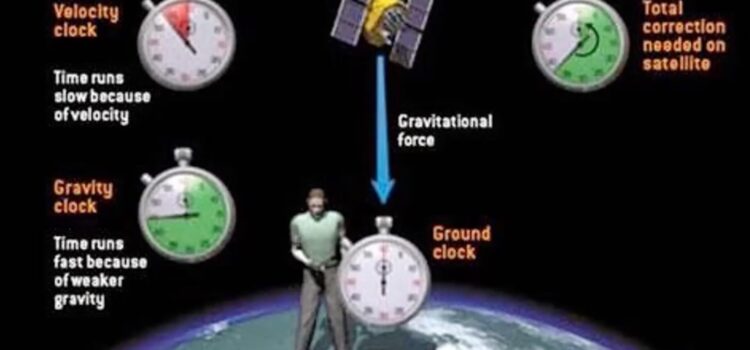
- GPS clocks have to run at a different speed to ground-based clocks due to gravity and velocity.
- Clock rates on the Moon examined by NIST in 2024
- Twin paradox – Earth-bound twin ages at a different rate than the other twin who travels through space.
- LTC is not a time zone, it’s a time scale.
- Lunar Halo photo – Randy Enkin
- Hexagonal ice crystals in Cirrus clouds
- Artemis II Mission to the Moon – Chris Gainor
- Send your name around the Moon – pin code and boarding pass
- Launch preparations – crew in quarantine and rocket on the launch pad
- Launch windows – 5 days in February and March, 6 days in April
- Earliest possible launch is Feb 6th
- Launch sequence and flight track – 10 days long
- 4-5,000 miles above Moon’s surface
- Heat shield
- Apollo verses the Artemis heat shields
- Artemis I heat shield had problems
- Re-entry track for Artemis II will be more gentle than the first mission to reduce exposure to heat
- Observing the Artemis II mission as it flies to the Moon could be photographed from Earth (with some difficulty).
- Jeremy Hansen’s mission patch – Natasha van Bentum
- 7 sacred indigenous laws
- For sale
- Aurora and hunt for Comet 24p/Schaumasse – Jan 20th early morning – David Lee
- VCO Jan 23 Observing Report – David Lee and Reg Dunkley
- Saturn & moons, Jupiter & moons, M42 trapezium, the Moon
- Need new Members-In-Charge to host observing sessions
- Bring your camera to attach to the back of the Takahashi to take some lovely photos of the celestial objects
- Dobsonian is great for visual observing
- Events
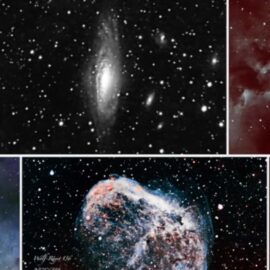
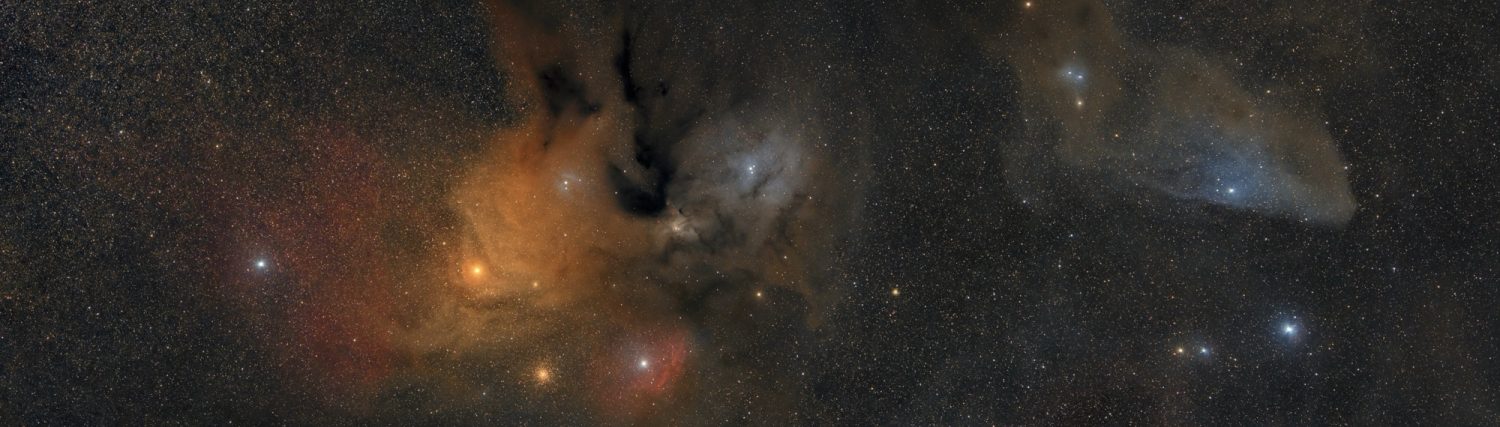
- Jan 28 – Astrophotography SIG
- Jan 31 – Artemis II Preview to Launch party at the Centre of the Universe
- Feb 2 – Astro Cafe
- Feb 9 – online only AGM – info sent to members
- Feb 23 – Victoria Centre awards and social dinner at the Four Mile Pub – contact Lauri Roche to reserve your spot – lauri@victoria.rasc.ca
Video recording of meeting
Astronomy Cafe – Jan 26, 2026